What does smoking do to your body?
Cigarettes are legal, easy to find, and still commonly used. Because of that, smoking can start to feel normal, even when we know it is harmful. We see warning labels on cigarette packs, scary ads before movies, and disclaimers that say “smoking is injurious to health.” But at the same time, movies and shows often make smoking look stylish, rebellious, or cool.
That mixed message can be confusing. Over time, people may even start joking about the scary anti-smoking ads shown before films, instead of thinking about what those warnings are trying to say.
Why is smoking so normalised?
Research has found that seeing smoking in movies is linked with a higher chance of young people starting to smoke. A systematic review found that adolescents with higher exposure to smoking in films were more likely to start smoking than those with lower exposure. Studies on warning labels also show that warnings can improve people’s knowledge of smoking risks, but the message often has to compete with years of social and cultural normalization.
So, in this blog, let’s move past the mixed signals and let’s really try to understand what smoking actually does to your body.
What Happens When You Smoke a Cigarette?
When you smoke a cigarette, the effects start almost immediately. Even before long-term damage develops, the body reacts to the chemicals in tobacco smoke within seconds to minutes.
Nicotine reaches the brain quickly
Nicotine is one of the main reasons cigarettes are so addictive. When you inhale cigarette smoke, nicotine enters your lungs, moves into your blood, and begins reaching your brain very quickly, within tens of seconds after inhalation. Once it reaches the brain, it affects nicotine receptors and increases the release of dopamine, a brain chemical linked with pleasure and reward.
This is why some people feel a short “rush” after smoking. They may feel more alert, calm, or focused for a little while. But this feeling does not last long.
Over time, the brain starts expecting nicotine. When nicotine levels drop, the person may feel irritated, restless, anxious, low, or unable to concentrate. These uncomfortable feelings are called withdrawal symptoms.
Smoking another cigarette gives short-term relief, but it also strengthens the cycle of craving and dependence. A review on tobacco and nicotine use explains that nicotine affects the brain’s reward system and plays a key role in addiction.
Carbon monoxide reduces oxygen in the blood
Cigarette smoke also contains carbon monoxide. This is the same poisonous gas that can come from car exhaust or faulty heaters. When carbon monoxide enters the blood, it attaches to hemoglobin, the part of red blood cells that normally carries oxygen.
The problem is that carbon monoxide takes up space where oxygen should be. This reduces the blood’s ability to carry oxygen around the body. Research on smokers hospitalized with acute cardiac events notes that cigarette smoking produces carbon monoxide, which can reduce the oxygen-carrying capacity of blood.
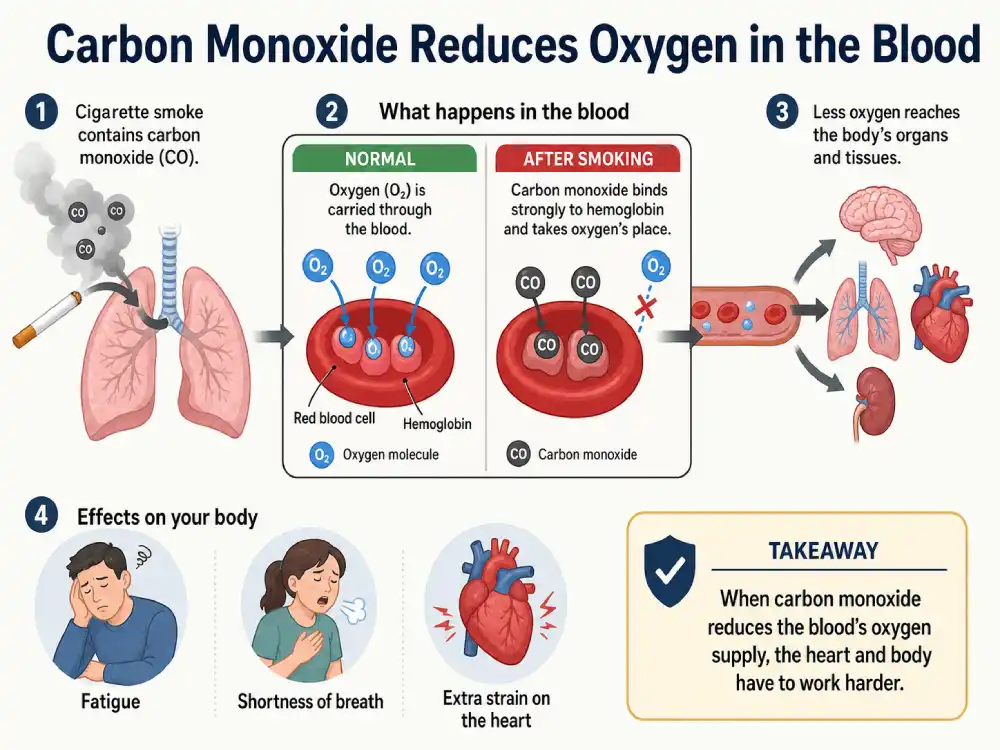
This means your heart, brain, muscles, and other organs may receive less oxygen than they need. That can make a person feel tired, breathless, or weak, especially during physical activity. The heart may also have to work harder to deliver enough oxygen to the body. For someone who already has heart disease, this extra strain can be dangerous.
Blood vessels tighten and heart rate rises
Smoking also affects the heart and blood vessels very quickly. Nicotine activates the body’s “fight-or-flight” system. This can make the heart beat faster and cause blood vessels to tighten. When blood vessels become narrower, blood has less space to move through, so blood pressure can rise.
This puts extra pressure on the cardiovascular system, the heart, blood, and blood vessels. A systematic review on smoking and cardiovascular disease notes that nicotine and carbon monoxide are harmful substances in cigarette smoke, and that smoking can have an almost immediate effect on the heart and blood vessels, including increased heart rate.
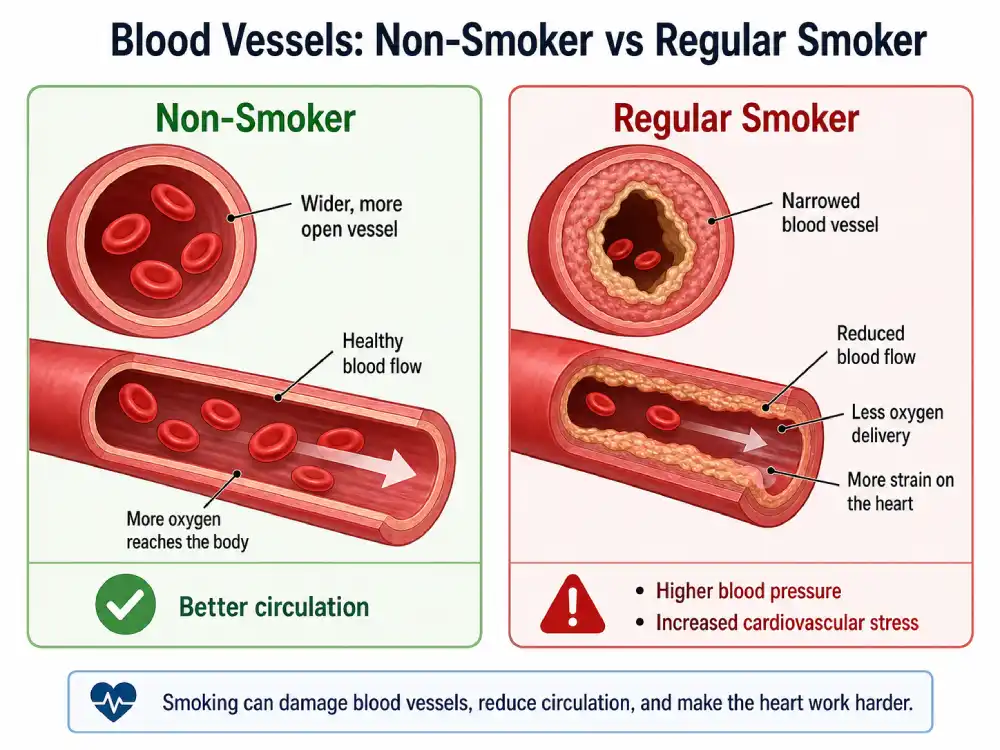
The American Heart Association also states that blood pressure increases in the short term every time a person smokes. Over time, this repeated stress can damage blood vessels and increase the risk of serious problems like heart disease, heart attack, and stroke.
How Smoking Affects Your Lungs
Your lungs are one of the first parts of the body to face cigarette smoke directly. With every puff, smoke travels through your throat, windpipe, airways, and deep into the lungs, where oxygen normally enters the blood. Tobacco smoke contains many toxic chemicals that can injure the airways and the tiny air sacs where oxygen exchange happens.
Cigarette smoke irritates the lining of the airways. These airways are the tubes that carry air in and out of your lungs. When they are repeatedly exposed to smoke, they can become swollen, sensitive, and inflamed.
This irritation can lead to symptoms like:
- coughing
- wheezing
- chest tightness
- extra mucus or phlegm
- shortness of breath
- frequent chest infections
Normally, the lungs have small cleaning systems that help remove dust, germs, and mucus. One of these systems includes tiny hair-like structures called cilia. They help sweep mucus and harmful particles out of the lungs. Cigarette smoke can damage this cleaning system, making it harder for the lungs to clear out mucus and germs. Reports show that cigarette smoke can impair mucociliary clearance, which is one way the lungs normally defend themselves.
When mucus stays trapped, it can make coughing worse. It can also create a place where germs grow more easily. This is one reason people who smoke may get respiratory infections more often.
Smoking increases the risk of death from pneumonia and causes chronic bronchitis. Chronic bronchitis is when the airways stay irritated for a long time and produce too much mucus. This often causes a long-lasting “smoker’s cough.”
It damages tiny air sacs in the lungs
Deep inside your lungs are tiny air sacs called alveoli. These sacs are where oxygen moves from the air into your blood. They also help remove carbon dioxide, a waste gas, from the body.
You can think of healthy alveoli like tiny balloons. They stretch when you breathe in and help push air out when you breathe out. Smoking can damage the walls between these air sacs. Over time, many small air sacs can break down into fewer, larger, weaker spaces. This condition is called emphysema.
When this happens, the lungs lose some of their stretch. Air can get trapped inside, and it becomes harder to breathe out fully. Because there are fewer healthy air sacs, less oxygen can pass into the blood. That means the body may not get the oxygen it needs as easily.
A long-term study on smoking patterns found that heavy, stable smokers had much higher odds of developing emphysema on CT scans compared with never-smokers. The same study also linked smoking patterns with later obstructive lung disease, which means airflow through the lungs becomes blocked or limited.
It increases the risk of COPD and lung cancer
Smoking is one of the main causes of COPD, or chronic obstructive pulmonary disease. COPD is not just one disease. It usually includes long-term airway problems like chronic bronchitis and emphysema.
In COPD, the lungs become damaged in ways that make breathing harder. The airways may be inflamed and narrowed. The lungs may produce too much mucus. The air sacs may lose their shape and strength. Together, these changes make it harder for air to move in and out. The CDC also states that cigarette smoking is a common cause of COPD and is responsible for as many as 8 out of 10 COPD-related deaths.
Smoking also greatly increases the risk of lung cancer. Tobacco smoke contains carcinogens, which are substances that can damage cells and increase the chance of cancer. When these chemicals repeatedly reach the lungs, they can damage the cells lining the airways and lung tissue. Over time, some damaged cells can start growing out of control.
The key point is simple: smoking does not just make the lungs “dirty.” It can inflame the airways, damage the air sacs, reduce oxygen exchange, and raise the risk of serious diseases like COPD and lung cancer.
How Smoking Affects Your Heart and Blood Vessels
Smoking does not only harm the lungs. It also affects the heart, blood, and blood vessels. These parts work together to move oxygen-rich blood around the body. When cigarette smoke enters the body again and again, it can damage this system and make the heart work harder.
Smoking raises the risk of heart disease
Smoking increases the risk of heart disease in several ways. It can damage the cells that line the inside of blood vessels. When this lining is injured, fatty material called plaque can build up more easily inside the arteries. Over time, this plaque can make the arteries narrower and stiffer.
This process is called atherosclerosis. In simple words, it means the blood vessels become clogged and less flexible. When arteries become narrow, less blood can flow through them. This means the heart may not get enough oxygen-rich blood, especially during exercise or stress.
Cigarette smoke can also make blood more likely to clot. A clot can partly or fully block blood flow. If this happens in an artery that supplies the heart, it can lead to a heart attack. The CDC states that smoking can increase plaque buildup, thicken and narrow blood vessels, damage blood vessel lining, and make blood sticky and more likely to clot.
Smoking increases stroke risk
A stroke happens when blood flow to part of the brain is blocked, or when a blood vessel in the brain bursts. Smoking can increase the risk of both types of stroke.
One reason is that smoking damages blood vessels. Damaged blood vessels are more likely to become narrow, weak, or blocked. Smoking can also make the blood more likely to form clots. If a clot travels to the brain or forms in a blood vessel that supplies the brain, it can stop oxygen from reaching brain cells.
Smoking harms circulation
Good circulation means blood can move easily to every part of the body, including the hands, feet, skin, muscles, and organs. Smoking can harm circulation by narrowing blood vessels and reducing blood flow.
When less blood reaches the arms and legs, a person may notice symptoms such as cold hands or feet, leg pain while walking, numbness, or slower healing after a cut or injury. This happens because blood carries oxygen and nutrients that tissues need to stay healthy and repair themselves.
Smoking is also strongly linked with peripheral artery disease, or PAD. PAD happens when narrowed arteries reduce blood flow to the limbs, especially the legs. A review on smoking and PAD describes cigarette smoking as a major preventable risk factor for PAD and explains that artery narrowing in PAD can reduce blood flow to the limbs and, in severe cases, lead to limb ischemia, meaning the tissue does not get enough blood and oxygen.
How Smoking Increases Cancer Risk
Cigarette smoke contains cancer-causing chemicals
Cigarette smoke is not just “smoke.” It is a mixture of thousands of chemicals. Research on tobacco smoke explains that cigarette smoke contains many carcinogenic and pre-carcinogenic agents. These include chemicals such as polycyclic aromatic hydrocarbons, tobacco-specific nitrosamines, benzene, and other substances that can damage DNA and contribute to cancer development.
One review on tobacco smoke and DNA damage explains that tobacco smoke contains more than 70 carcinogens. Some directly damage DNA, while others become harmful after the body processes them.
Smoking can damage DNA and change how cells grow
Cancer often begins when normal cells collect enough damage to start behaving abnormally. Smoking can speed up this process by causing changes, or mutations, in DNA.
A review on tobacco smoke and lung cancer explains that chemicals in cigarette smoke can interact with DNA and cause genetic changes. These changes can affect important genes that normally help control cell growth and repair damage.
Another review found that p53 mutations in lung cancers can be linked to direct DNA damage from cigarette smoke carcinogens. The p53 gene is important because it helps protect the body from cancer by stopping damaged cells from growing. When this gene is damaged, abnormal cells may be more likely to survive and multiply.
This is why smoking-related cancer does not usually happen overnight. It often develops after years of repeated injury to the cells.
Smoking can cause cancer in many parts of the body
Many people connect smoking only with lung cancer, but smoking can increase cancer risk in several parts of the body. This is because harmful chemicals from tobacco smoke can enter the blood and travel beyond the lungs.
The Surgeon General’s report explains that smoking is linked with many diseases, including cancers in different parts of the body. Smoking is known to increase the risk of cancers of the:
- lungs
- mouth
- throat
- voice box
- esophagus
- bladder
- kidney
- pancreas
- stomach
- liver
- cervix
- colon and rectum
Smoking can also increase the risk of acute myeloid leukemia, a cancer of the blood-forming cells.
Smoking is the main cause of lung cancer
The lungs receive cigarette smoke directly, so they are especially exposed to harmful chemicals. These chemicals can damage the cells that line the airways and lung tissue.
Over time, damaged lung cells may start growing out of control. This can lead to lung cancer. A review on tobacco smoke and genetic damage states that lung cancer is a leading cause of cancer death and that smoking is the major contributing factor.
The risk is also affected by how much and how long someone has smoked. In general, the more cigarettes a person smokes and the longer they smoke, the higher the risk. But even people who smoke less are still exposed to cancer-causing chemicals.
Quitting lowers cancer risk
The good news is that quitting smoking can reduce cancer risk. The body cannot always undo all past damage, but stopping smoking reduces future exposure to cancer-causing chemicals. Over time, the risk of several smoking-related cancers goes down after quitting. The earlier a person quits, the more time the body has to recover and lower future risk.
How Smoking Affects the Brain and Mental Health
Smoking affects the brain very quickly because nicotine can reach the brain soon after a person inhales cigarette smoke. This is one reason cigarettes can become addictive. The brain starts to connect smoking with short-term relief, pleasure, focus, or calmness, even though the effect does not last.
Nicotine changes the brain’s reward system
Nicotine affects a part of the brain that is involved in reward and motivation. It can increase the release of dopamine, a brain chemical linked with pleasure and reinforcement. This dopamine release can make the brain “learn” that smoking feels rewarding, which makes a person want to repeat it.
Over time, the brain can become used to nicotine. This is called tolerance. When tolerance develops, a person may need to smoke more often to feel the same effect. When nicotine levels drop, the person may feel uncomfortable, restless, irritated, low, or unable to focus. These are withdrawal symptoms.
Smoking may feel calming, but withdrawal fuels stress
Many people smoke because they feel it helps them relax. A cigarette may seem to reduce stress for a short time. But often, that “relief” happens because nicotine withdrawal is being eased.
A major review found that stopping smoking is linked with reduced depression, anxiety, and stress, and improved mood and quality of life compared with continuing to smoke. This suggests that smoking may feel like it helps in the moment, but quitting can support better mental health over time.
Smoking can affect focus, mood, and sleep
Nicotine is a stimulant, which means it can make the brain feel more alert for a short time. Some people smoke because they feel it helps them concentrate. But this effect is temporary. When nicotine wears off, cravings and withdrawal can make it harder to focus.
Smoking can also affect sleep. Nicotine can make it harder to fall asleep or stay asleep, especially when someone smokes close to bedtime. Poor sleep can then worsen mood, stress, and concentration the next day.
How Smoking Affects Your Skin, Teeth, and Appearance
Smoking affects parts of the body that people can often see: the skin, lips, teeth, gums, hair, and nails. These changes may seem “cosmetic,” but many of them happen because smoking reduces blood flow, increases inflammation, and exposes the body to harmful chemicals.
Healthy skin needs oxygen, nutrients, and good blood flow. Smoking can reduce blood flow to the skin and expose skin cells to oxidative stress. Oxidative stress is damage caused by unstable molecules that can injure cells and tissues.
Over time, this can make the skin look older than it would otherwise. People who smoke may notice:
- deeper wrinkles
- dull or uneven skin tone
- dry-looking skin
- loss of skin elasticity
- more visible lines around the mouth and eyes
A review on tobacco smoke and skin aging explains that smoking is linked with wrinkles, pigmentation changes, and signs of premature skin aging. It also notes that tobacco smoke can affect the skin through oxidative stress and molecular changes in skin tissue.
Smoking can slow down skin healing
When the skin is injured, the body needs oxygen-rich blood to repair the wound. Smoking can make this harder. Carbon monoxide can reduce how much oxygen the blood carries, while nicotine can narrow blood vessels. Together, these effects can mean less oxygen reaches healing tissue.
This is why cuts, surgical wounds, or skin injuries may heal more slowly in people who smoke. A randomized controlled study found that smoking was linked with impaired wound healing, including higher wound rupture rates compared with nonsmokers.
Smoking stains teeth and harms gums
Cigarette smoke can stain the teeth, leaving them yellow or brown over time. It can also cause bad breath because smoke particles stay in the mouth and lungs.
But smoking does more than stain teeth. It can also harm the gums. Smoking affects blood flow and immune response in the mouth, which can make it harder for the gums to fight infection. This raises the risk of gum disease, also called periodontal disease.
Does “Light” or Occasional Smoking Still Harm the Body?
Some people do not smoke every day. Some smoke only at parties, only when they drink, only when they are stressed, or only “one or two” cigarettes in a day. Because this feels less than regular smoking, it can seem safer.
Social smoking is still smoking. Even if someone smokes only with friends or at events, the body is still exposed to nicotine, carbon monoxide, and cancer-causing chemicals.
Nicotine can also train the brain to connect smoking with certain situations, like drinking alcohol, taking breaks, feeling stressed, or being around certain people. Over time, these situations can become triggers. This can make cravings stronger and make smoking more frequent.
“One cigarette a day cannot be that bad”
It may sound like one cigarette a day is too little to matter, but the body can still be affected. Cigarette smoke can raise heart rate, narrow blood vessels, reduce oxygen delivery, and expose cells to harmful chemicals.
The risk is especially important for the heart and blood vessels. A major meta-analysis in The BMJ looked at 141 cohort studies and found that smoking only about one cigarette per day carried a much higher risk of coronary heart disease and stroke than many people might expect. The authors concluded that people who smoke should aim to quit instead of only cutting down.
“I have smoked for years and feel fine”
Many smoking-related diseases develop slowly. A person can feel normal for years while damage is building inside the body.
For example, plaque can slowly build up in arteries. Lung tissue can gradually lose strength. DNA damage can collect in cells over time. These changes may not cause symptoms at first. But later, they can appear as chest pain, shortness of breath, chronic cough, heart disease, COPD, stroke, or cancer.
A large U.S. study on low-intensity and non-daily smoking found that even lifelong non-daily smokers had a higher risk of death than never-smokers. The study also found that risk increased with higher smoking intensity.
When to Get Help
Smoking can cause symptoms that are easy to ignore at first. A cough may seem “normal.” Feeling breathless may be blamed on being tired or out of shape. Chest tightness may be brushed off as stress.
But these symptoms can sometimes be signs that the lungs, heart, or blood vessels are under strain. It is better to get checked early than to wait until symptoms become serious.
You should consider speaking with a doctor if you notice:
- a cough that does not go away
- coughing that keeps getting worse
- wheezing or a whistling sound while breathing
- shortness of breath, especially during normal activities
- chest tightness or chest discomfort
- frequent chest infections
- feeling very tired without a clear reason
- unexplained weight loss
Do not ignore coughing up blood
Coughing up blood should always be taken seriously. It may come from the lungs or airways, and it can be a warning sign of a health problem.
Coughing up blood as a warning sign of lung disease. It also notes that unexplained chest pain lasting a month or more, especially if it gets worse when breathing in or coughing, should be checked.
You should seek medical help urgently if coughing up blood happens with chest pain, severe shortness of breath, dizziness, fainting, or a large amount of blood.
Get urgent help for sudden or severe symptoms
Some symptoms need emergency care. Do not wait if you or someone else has:
- sudden chest pain
- severe trouble breathing
- weakness or numbness on one side of the body
- sudden confusion
- trouble speaking
- sudden severe headache
- fainting
- blue lips or face
These can be signs of serious problems like a heart attack, stroke, or severe breathing emergency. Smoking increases the risk of heart disease and stroke by damaging blood vessels, increasing plaque buildup, narrowing blood vessels, and making blood more likely to clot.
Ask for help with quitting too
You do not need to wait until you feel sick to ask for help. A doctor, therapist, quitline, or smoking cessation program can help you make a quit plan.
This may include:
- nicotine patches, gum, or lozenges
- prescription medicines
- counseling or therapy
- support groups
- planning for cravings and triggers
- rehabilitation centers
Conclusion
Smoking may be common and legal, but that does not make it harmless. From the first puff, it can affect your brain, lungs, heart, blood vessels, skin, teeth, and long-term cancer risk. The damage can build slowly, even when you feel fine. But the good news is that quitting can help your body start healing and lower your risk of serious disease over time.
Sources
Centers for Disease Control and Prevention. (n.d.). Cigarettes and cardiovascular disease.
Centers for Disease Control and Prevention. (n.d.). Cigarettes and COPD.
Dani, J. A., Jenson, D., Broussard, J. I., & De Biasi, M. (2011). Neurophysiology of nicotine addiction. Journal of Addiction Research & Therapy, S1, 001.
Dillinger, J.-G., Pezel, T., Delmas, C., Schurtz, G., Trimaille, A., Piliero, N., Bouleti, C., Lattuca, B., Andrieu, S., Fabre, J., Rossanaly Vasram, R., Dib, J.-C., Aboyans, V., Fauvel, C., Roubille, F., Gerbaud, E., Boccara, A., Puymirat, E., Toupin, S., Vicaut, E., & Henry, P. (2024). Carbon monoxide and prognosis in smokers hospitalised with acute cardiac events: A multicentre, prospective cohort study. eClinicalMedicine, 68, 102401.
Hammond, D., Fong, G. T., McNeill, A., Borland, R., & Cummings, K. M. (2006). Effectiveness of cigarette warning labels in informing smokers about the risks of smoking: Findings from the International Tobacco Control Four Country Survey. Tobacco Control, 15(Suppl. 3), iii19–iii25.
Hughes, J. R., & Hatsukami, D. K. (1986). Signs and symptoms of tobacco withdrawal. Archives of General Psychiatry, 43(3), 289–294.
Leonardi-Bee, J., Nderi, M., & Britton, J. (2016). Smoking in movies and smoking initiation in adolescents: Systematic review and meta-analysis. Addiction, 111(10), 1750–1763.
Le Foll, B., Piper, M. E., Fowler, C. D., Tonstad, S., Bierut, L., Lu, L., Jha, P., & Hall, W. D. (2022). Tobacco and nicotine use. Nature Reviews Disease Primers, 8, 19.
National Center for Chronic Disease Prevention and Health Promotion, Office on Smoking and Health. (2010). How tobacco smoke causes disease: The biology and behavioral basis for smoking-attributable disease: A report of the Surgeon General. Centers for Disease Control and Prevention.
National Center for Chronic Disease Prevention and Health Promotion, Office on Smoking and Health. (2014). The health consequences of smoking—50 years of progress: A report of the Surgeon General. Centers for Disease Control and Prevention.
National Center for Chronic Disease Prevention and Health Promotion, Office on Smoking and Health. (2020). Smoking cessation: A report of the Surgeon General. Centers for Disease Control and Prevention.
National Heart, Lung, and Blood Institute. (n.d.). COPD symptoms.
Parmar, M. P., Kaur, M., Bhavanam, S., Mulaka, G. S. R., Ishfaq, L., Vempati, R., Faseel C, M., Kandepi, H. V., Rajagopal, E. R., Sahu, S., & Davalgi, S. (2023). A systematic review of the effects of smoking on the cardiovascular system and general health. Cureus, 15(4), e38073.
Pirie, K., Peto, R., Reeves, G. K., Green, J., & Beral, V. (2013). The 21st century hazards of smoking and benefits of stopping: A prospective study of one million women in the UK. The Lancet, 381(9861), 133–141.
Rigotti, N. A., Clair, C., Munafò, M. R., & Stead, L. F. (2012). Interventions for smoking cessation in hospitalised patients. Cochrane Database of Systematic Reviews, 5, CD001837.
Schane, R. E., Ling, P. M., & Glantz, S. A. (2010). Health effects of light and intermittent smoking: A review. Circulation, 121(13), 1518–1522.
Schane, R. E., Ling, P. M., & Glantz, S. A. (2010). Health effects of light and intermittent smoking: A review. Circulation, 121(13), 1518–1522.
U.S. Department of Health and Human Services. (n.d.). Health consequences of smoking: Surgeon General fact sheet.
U.S. National Cancer Institute. (n.d.). Harms of cigarette smoking and health benefits of quitting.
U.S. National Library of Medicine. (n.d.). Pulmonary diseases. In How tobacco smoke causes disease: The biology and behavioral basis for smoking-attributable disease.
U.S. National Library of Medicine. (n.d.). The health consequences of smoking: Cancer. In The health consequences of smoking—50 years of progress: A report of the Surgeon General.