The Hidden Cost of War: PTSD in Soldiers, Refugees, and Families
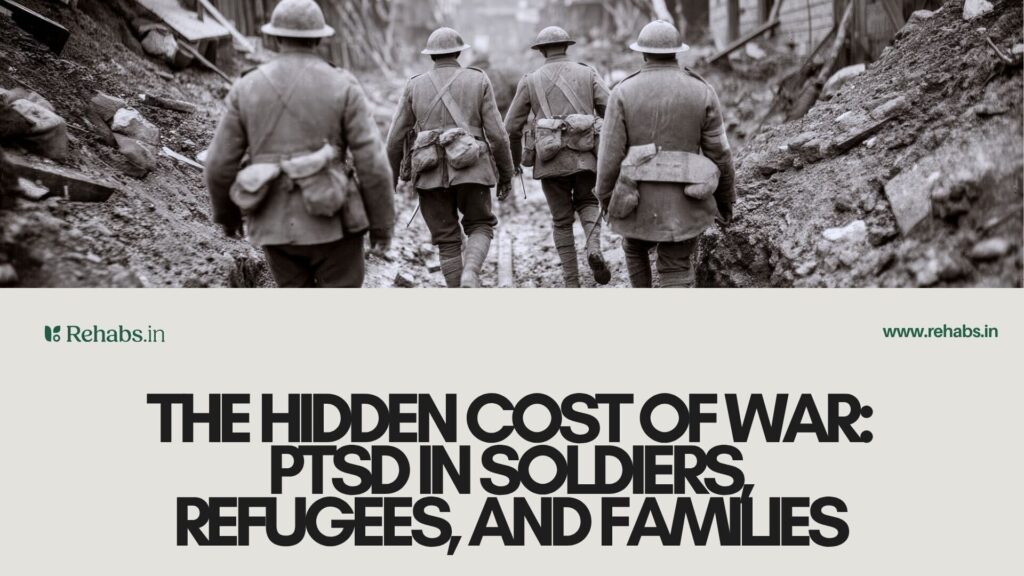
“In war, there are no unwounded soldiers.” This saying holds true not just for those who fight on the battlefield but also for the millions who live through its aftermath. The explosions stop, borders may be redrawn, but for many, the battle continues inside their minds.
Post-Traumatic Stress Disorder (PTSD) is one of war’s most silent and devastating consequences. It doesn’t leave visible scars but alters how people think, feel, and live long after the war has ended. While the physical damage of conflict is documented and discussed, the psychological toll often remains hidden, especially among soldiers, refugees, and families.
As wars continue to erupt across the world, from Ukraine to Gaza to ongoing border tensions in Asia, it’s time we address the unseen wounds that soldiers and civilians carry.
Soldiers on the Frontline
For soldiers, war doesn’t end when the guns go silent. The memories, sights, and sounds of the battlefield often replay endlessly in their minds. PTSD among soldiers is now recognized as one of the most common psychological consequences of combat.
In countries like the United States, studies show that between 11% and 20% of veterans from Iraq and Afghanistan have PTSD in a given year. Even decades later, Vietnam War veterans continue to experience flashbacks and nightmares. Many describe the feeling as being “stuck” in a moment that refuses to end, a gunshot, a scream, or the sight of a fallen comrade.
Situation in India
In India, large-scale wars may be rare today, but soldiers remain deployed in high-stress zones like Kashmir, the northeast, and border areas. A 2020 report by United Service Institution of India (USI) revealed that over half of Indian Army personnel are under severe stress, and tragically, more soldiers die by suicide than in combat each year.
The causes are complex, long deployments, lack of family time, and the stigma around seeking mental health support. Many soldiers are expected to “tough it out,” suppressing their pain until it becomes unbearable.
One US Marine Veteran shared that he attempted suicide four times before realizing he needed help. “It was easier to face the enemy,” he said, “than to face my own mind.”
The Unseen Battle
PTSD in soldiers often shows up as irritability, emotional numbness, insomnia, or an inability to trust others. Small triggers, a loud bang, fireworks, or even certain smells, can transport them back to the battlefield. Many also struggle with survivor’s guilt, asking themselves why they lived when others didn’t.
The real tragedy is that these invisible wounds are often dismissed or misunderstood. But mental health experts now emphasize that psychological care should be considered as essential as physical rehabilitation in post-war recovery.
Refugees: Fleeing War, But Not the Trauma
For millions of civilians caught in war, survival often means fleeing their homes and everything familiar. But while they may escape the physical danger, the trauma of what they’ve seen and endured follows them wherever they go.
A 2022 report on the Ukrainian war estimated that around 10 million people may develop mental health conditions, including PTSD, as a result of ongoing violence. In refugee camps across Europe and the Middle East, aid workers report that people live in a constant state of fear and uncertainty.
“Everyone [in Afghanistan] is exposed to chronic fear and vulnerability… It keeps people in a state of high alert…wears down our bodies and minds,” explains psychologist Kenneth Miller, describing how decades of conflict have traumatized Afghans. For those who flee, the trauma travels with them: Dr. Waheed Arian, an Afghan who grew up amid bombings, recalls becoming “detached from reality,” unable to eat or sleep – classic PTSD and depression symptoms. Even after resettling abroad, nightmares and anxiety plague him as he worries for family back home. Studies among Syrian war refugees reveal staggering PTSD rates – in some samples over half (50–60%) of refugees test positive for PTSD.
Refugee Trauma in India
India, too, hosts thousands of refugees, from Sri Lanka, Tibet, Myanmar, and Afghanistan. While they find safety here, many continue to live with the psychological scars of war. In one study of Sri Lankan Tamil refugees in Tamil Nadu, researchers found high levels of PTSD, depression, and anxiety, even years after resettlement.
Many refugees also face new stressors after displacement: poverty, language barriers, uncertain legal status, and the loss of identity. These secondary traumas can deepen existing wounds, making recovery even harder.
The Need for Mental Health Support
While global humanitarian organizations provide food, shelter, and medical aid, mental health services often remain underfunded. Simple interventions, like trauma-informed counseling, community support groups, and safe spaces for children, can make a world of difference. Unfortunately, these services are still scarce in many refugee settings.
Families and Children: The Ripple Effect of War
War doesn’t only break soldiers or drive refugees to flee, it also tears apart the families who stay behind. The trauma of war ripples through generations, affecting spouses, parents, and especially children.
Families of Soldiers
For families of soldiers, every phone call or news report brings anxiety. When soldiers return home with PTSD, loved ones often find themselves walking on eggshells, unsure what might trigger a flashback or an outburst. Partners may feel emotionally disconnected; children may not understand why their parent has changed.
In India, many army families have quietly carried these burdens. The lack of awareness and resources for military families means that spouses and children often bear the emotional brunt without support. Counseling and community programs are slowly being introduced, but the stigma still prevents many from seeking help.
Children of War
Children are among the most vulnerable victims of war. When homes turn into battlefields, their developing minds absorb more than we can imagine. Studies show that in areas affected by war, such as Gaza, Syria, and Ukraine, a significant number of children show symptoms of PTSD.
These symptoms can include bed-wetting, aggression, nightmares, or difficulty concentrating in school. Even after escaping the war zone, children may panic at loud noises or withdraw socially. Some become unusually mature, taking on adult responsibilities too soon, while others regress emotionally.
The Cycle of Generational Trauma
Psychologists have found that trauma can be “inherited,” not genetically, but emotionally and behaviorally. Parents who have unresolved trauma may unintentionally pass it on through their reactions, fears, or silence. For example, children of Holocaust survivors or war veterans often display anxiety or hyper-vigilance even without direct exposure to violence.
In regions like Kashmir or Afghanistan, where conflict has lasted for decades, this generational trauma is widespread. Entire communities live with a collective sense of grief, anger, and fear that becomes normalized over time. Breaking this cycle requires both individual healing and societal acknowledgment of the pain.
The Science of PTSD: What Happens in the Brain
PTSD is not a sign of weakness, it’s the brain’s natural response to overwhelming stress. When someone faces extreme danger, the body’s “fight-or-flight” system activates. In war, that system stays on for months or years, flooding the body with stress hormones.
After returning to safety, the brain sometimes fails to “switch off” this response. The amygdala (the brain’s fear center) stays hyperactive, while the hippocampus (responsible for memory) struggles to differentiate between past and present danger. This is why a loud sound or a flash of light can trigger a full-blown panic attack.
PTSD can also alter how people process emotions, trust others, and regulate sleep or appetite. Over time, untreated trauma can lead to depression, substance use, or even physical illnesses like heart disease and chronic pain.
Understanding PTSD as a biological and psychological condition, rather than a personal flaw, is key to helping survivors seek help without shame.
Options for Recovery
The good news is that PTSD is treatable. With the right combination of therapy, medication, and social support, many people can rebuild their lives and even grow stronger through their experiences.
Therapy and Counseling
Therapy is often the cornerstone of recovery. Cognitive Behavioral Therapy (CBT) helps individuals identify and change negative thought patterns. Exposure therapy allows people to confront their traumatic memories in a safe and controlled way.
Another highly effective method is Eye Movement Desensitization and Reprocessing (EMDR), which helps the brain reprocess traumatic memories through guided eye movements. Group therapy also allows survivors to share their experiences, reducing isolation and shame.
Medication and Medical Support
In some cases, antidepressants or anti-anxiety medications can help manage severe symptoms. These aren’t cures but can make it easier for individuals to engage in therapy and rebuild daily routines.
The Power of Social Support
Healing doesn’t happen in isolation. Having family, friends, and community support makes a significant difference. Veterans’ organizations, refugee groups, and counseling centers play an important role in providing safe spaces for people to talk and connect.
In India, the armed forces are beginning to recognize this need. Some regiments have introduced peer counseling programs and workshops on emotional resilience. Civilian NGOs have also started offering trauma recovery programs for displaced families and children.
Early Intervention and Education
Experts emphasize that the earlier someone receives help after a traumatic event, the better their chances of recovery. “Psychological first aid,” listening without judgment, ensuring safety, and connecting people to resources, can prevent long-term damage.
In countries like India, where mental health is still stigmatized, public education is crucial. Normalizing therapy, especially for soldiers and trauma survivors, can save lives. Schools and communities can also play a role by teaching children about emotional regulation and offering safe spaces to share their feelings.
Conclusion
The true cost of war cannot be captured by statistics or victory parades. It lives on in the silent struggles of soldiers who can’t sleep, refugees haunted by what they’ve fled, and families piecing their lives back together. PTSD is not a weakness, it’s a human response to unimaginable pain.
Recognizing and addressing these hidden wounds is not just a matter of mental health; it’s a moral responsibility. By offering empathy, early intervention, and sustained care, societies can help survivors reclaim their peace.
Sources:
American Psychiatric Association. (2022). Diagnostic and Statistical Manual of Mental Disorders (5th ed., text rev.). Washington, DC: Author.
De Vries, J. (2001). Mental health issues in Tamil refugees and displaced persons. Patient Education and Counseling, 42(1), 15–24.
Goreau-Ponceaud, A. (2024). Lives in exile? Perspectives on the resettlement of Sri Lankan Tamil refugees in Tamil Nadu, India. World Development, 176, 106–119.
International Committee of the Red Cross. (2019). Living through war: Mental health of children and youth in conflict-affected areas. International Review of the Red Cross, 101(911), 467–495.
Jensen, T. K., & Rasmussen, A. (2000). Prevalence of war-related post-traumatic stress disorder in adolescents: A meta-analysis. European Child & Adolescent Psychiatry, 9(4), 185–192.
Murthy, R. S., & Lakshminarayana, R. (2010). Mental health consequences of war: A brief review of research findings. World Psychiatry, 9(1), 37–40.
Society for Policy Research Foundation. (2024). Mental health in the Indian Armed Forces and Central Armed Police Forces: Discussion paper.
United Service Institution of India (USI). (2020). Study on stress levels of Indian Army personnel. New Delhi: USI of India.
World Health Organization. (2022). Post-traumatic stress disorder (PTSD) fact sheet. Geneva: Author.
World Health Organization. (2023). Mental health of refugees and migrants: Key facts and policy considerations. Geneva: Author.
Times of India. (2024, July 7). Kargil 25 years: Back from dead & sans limb, Major Devender Pal Singh now inspires the world.
Indian Express. (2022, November 5). How this Kargil war veteran came back from the dead to become India’s first blade runner.
Bhatia, J. K. (2022). The psychological first aid approach for trauma survivors. The Hindu Health Supplement.
Sahoo, I., Amona, E., Kuttikat, M., & Chan, D. (2024). Enhancing mental health predictions: A gradient boosted model for Sri Lankan camp refugees. Social Sciences, 13(5), 255.