Is There a Male Loneliness “Crisis”? Looking at the Evidence
Over the last few years, loneliness has increasingly been described as a public health concern. What began as a broad conversation about social isolation, accelerated by the COVID-19 pandemic, has gradually narrowed into a more specific and emotionally charged narrative: a male loneliness “crisis.” Media articles, podcasts, and online discussions now frequently suggest that men, in particular, are becoming more isolated, disconnected, and emotionally unsupported.
At the same time, this idea has sparked strong reactions. Some view male loneliness as an overlooked mental health issue that deserves serious attention. Others dismiss it as exaggerated, self-pitying, or even a backlash against changing gender norms. Much of the debate unfolds online, often framed through blame, ideology, or anecdote rather than evidence.
This blog takes a step back from those polarized narratives. Instead of asking who is at fault, it asks a more careful question: What does the data actually show? Are men experiencing loneliness at higher rates than women? Has loneliness been increasing over time? Is this best understood as a men’s issue, a youth issue, or part of a broader societal shift in how people form and maintain relationships?
What do we mean by loneliness?
Loneliness is often misunderstood as simply being alone. In psychology, loneliness is defined as a subjective feeling of distress that arises when a person perceives a gap between the social connections they want and the connections they have (Perlan & Peplau, 1981). This means someone can feel lonely even when surrounded by people and not feel lonely while being physically alone.
It is important to distinguish loneliness from related concepts:
- Loneliness is about how connected someone feels.
- Social isolation refers to an objective lack of social contacts or interactions.
- Solitude can be voluntary and restorative, and does not necessarily involve distress.
A key reason loneliness and social isolation are often confused is that they are related but driven by different mechanisms. Social isolation is largely about the number and frequency of social contacts, while loneliness is shaped by the quality of those interactions and the expectations people have from them.
Loneliness tends to arise when relationships lack emotional closeness, trust, or mutual understanding, or when there is a mismatch between the level of connection a person wants and what they actually experience. This is why some people with many social ties still feel lonely while others with smaller networks feel emotionally fulfilled.
How is loneliness measured in research?
Most large studies measure loneliness using either:
- Single-item questions, such as “How often do you feel lonely?”
- Validated scales, most commonly the UCLA Loneliness Scale, which assesses feelings of social and emotional disconnection across multiple items (Russell, 1996). The scale includes statements such as “I feel left out,” “I lack companionship,” and “There are people I can turn to”(reverse scored), and asks respondents how often they feel this way.
Most research involves one or more of these elements of loneliness:
- Self-perception: whether someone personally feels lonely or disconnected
- Close relationships: the number of close friends or trusted people they have
- Emotional connection: whether they feel understood, supported, and able to be themselves with others
- Belonging: whether they feel included in groups, communities, or shared social spaces
- Reliance on support: whether they believe someone would be there for them in times of need
Single item measures are easier to use in large surveys but may miss nuance. Multi-item scales provide more depth but are less commonly used in national datasets. This difference in measurement partly explains why findings about loneliness vary across studies.
Another important consideration is reporting style. Some research suggests men may be less likely to label their experience as “loneliness,” even when they report related feelings like emptiness, boredom, or lack of purpose (Borys & Perlman, 1985). This does not mean men feel less loneliness but it may be expressed or reported differently.
Where did the “loneliness epidemic” narrative come from?
The idea of a “loneliness epidemic” did not begin as a gendered claim. It first emerged in public health and psychology in the early 2000s, when researchers started documenting rising social isolation, shrinking social networks, and declining community participation in several high-income countries (Putnam, 2000; Holt-Lunstad et al., 2015). These early discussions focused on population-level risks, linking social disconnection to poorer mental and physical health outcomes rather than to any specific group.
The term gained wider public attention in the late 2010s, particularly after large meta-analyses showed that loneliness and social isolation were associated with increased mortality risk, comparable to well-known health risk factors. During the COVID-19 pandemic, prolonged lockdowns, remote work, and reduced social contact further amplified concerns, pushing loneliness into mainstream policy and media conversations.
Only more recently did the narrative shift toward men. The shift was driven less by new evidence of men being uniquely lonelier, and more by data showing declines in close friendships among men, increased reliance on romantic partners for emotional support, and growing online discussions around masculinity, dating, and social disconnection. As a result, a broad public-health concert gradually become reframed in popular discourse as a “male loneliness” issue.
What does the data actually say?
Are men lonelier than women?
Across most large population surveys, men do not consistently report higher loneliness than women. In many countries, average loneliness scores are either similar across genders or show small differences that change depending on age, measurement method, and context. Some studies even find women reporting slightly higher loneliness.
One of the largest recent surveys (6700+ respondents) found no overall gender gap in loneliness. The only clear difference appeared among young people aged 15-34, where young women reported highest levels of loneliness. This suggests that age may be a stronger predictor than gender in many cases.
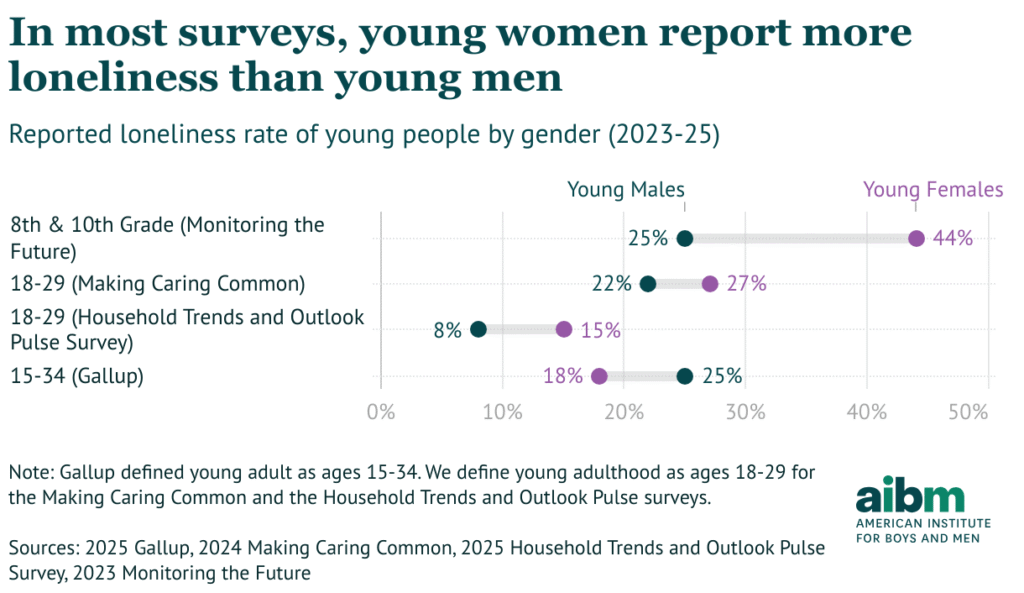
These patterns do not necessarily mean that young men are less lonely. Instead, they highlight how loneliness measurement depends heavily on self-perception and willingness to label one’s experience as loneliness. Research suggests that women, on average, may be more comfortable acknowledging emotional distress, while men may express disconnection through other indicators such as reduced friendships, emotional withdrawal, or reliance on romantic partners for support.
Where the evidence is stronger: friendships and social support
While loneliness scores themselves do not show a large or consistent male disadvantage, other indicators tell a more specific story. Compared to 1990, five times more men now report having no close friends. Men also tend to rely more heavily on a romantic partner as their primary source of emotional support, which can increase vulnerability if that relationship ends or is absent.
Importantly, the gender gap in close friendships is small, but it exists. Close friendships are more protective against loneliness and poor mental health than casual social contact.
Is loneliness increasing overall?
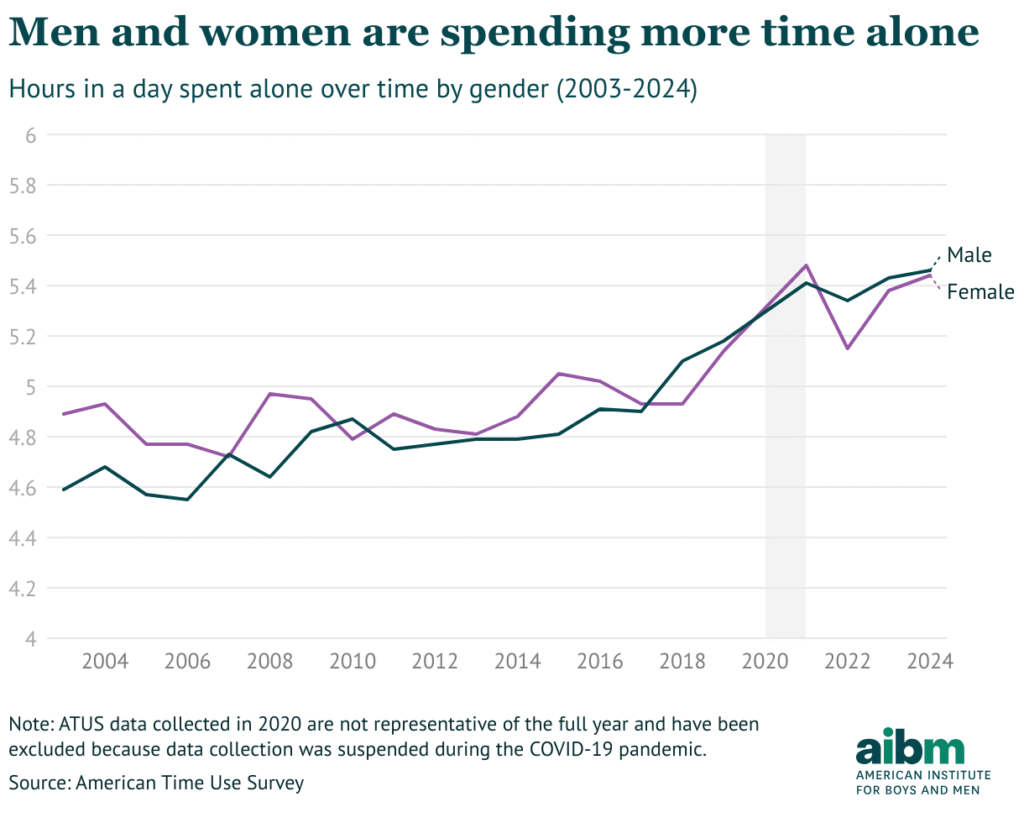
Data suggests that both men and women are spending more time alone than in previous decades. However, increases in loneliness are not uniform or linear. Some studies show modest rises, others show stability, and some show decline in certain age groups. The inconsistency reflects differences in how loneliness is measured and which populations are being studied.
Life stage, class, and education matter more than gender
Across databases, socioeconomic factors such as education and income show larger gaps in loneliness than gender alone. Patterns also vary strongly by life stage. Adolescence and young adulthood consistently show highest loneliness levels, while midlife and older adulthood show different, often more stable, patterns.
Mental health and suicide statistics
Men are around four times more likely than women to die by suicide, a statistic often cited in discussions of male loneliness. While loneliness is a known risk factor for suicide, research does not support a simple or direct causal link. Suicide risk is shaped by multiple interacting factors, including mental health, substance use, access to support, and help-seeking behavior.
What the data does and does not support
Overall, the evidence does not strongly support the idea that men are uniquely or universally lonelier than women. What it does support is a more specific claim: men, on average, appear to be losing close friendships and relying on narrower sources of emotional support, especially at certain life stages.
Taken together, these finding point toward a broader youth loneliness concern. Gender differences exist, but they are context-specific and closely tied to how loneliness is defined, measured, and expressed.
How is the internet responding to loneliness and why it often gets framed as a male problem
In many online spaces, loneliness is discussed with empathy and concern. Mental health professionals, educators, and young people themselves describe loneliness as a consequence of emotional suppression, shrinking social circles, academic and economic pressure, and reduced opportunities for community connection.
Dismissal and the “self-pity” narrative
Alongside empathy, there is also strong dismissal. Some online responses frame loneliness, especially when expressed by men, as self-pity, weakness, or entitlement. In these discussions, loneliness is treated as something individuals should “get over” through self-improvement or resilience alone. This response often overlooks the evidence showing that loneliness is shaped by structural and relational factors, and it can reinforce stigma around emotional vulnerability, particularly among young men.
Why the narrative skews male online
Although young women often report equal or higher loneliness in surveys, young men tend to express loneliness more visibly in online forums, podcasts, and comment sections. This visibility is partly due to differences in socialisation: men are generally less likely to seek formal mental health support and may rely more heavily on anonymous or semi-anonymous digital spaces to articulate distress. As a result, male loneliness becomes more visible online, even when it is not more prevalent overall.
Echo chambers and emotional amplification
Digital platforms can intensify loneliness through echo chambers. Algorithms tend to promote emotionally charged content, repeatedly exposing users to narratives of isolation, rejection, or grievance. While online communities can offer validation and a sense of belonging, they can also reinforce hopelessness or resentment, especially when loneliness is framed as permanent, externally caused, or unsolvable without status or dominance.
The role of “alpha male” and grievance-based influencers
In some online spaces, loneliness is reframed through rigid ideas of masculinity. So-called “alpha male” influencers often interpret loneliness as evidence that men have lost power, status, or sexual access due to feminism, modern dating culture, or women’s autonomy. These narratives promote solutions focused on dominance, emotional detachment, financial success, or sexual conquest, while dismissing vulnerability and mutual connection as weakness.
From a psychological standpoint, this framing is misleading. Research consistently shows that emotional suppression, rigid gender roles, and reduced relational intimacy are associated with poorer mental health and weaker social bonds. While these influencers may offer short-term validation or a sense of identity, they often discourage the very skills, emotional awareness, reciprocity, trust, and friendship maintenance that protect against loneliness.
Why Loneliness Matters: Psychological, Social, and Health Consequences
Loneliness is not just an uncomfortable feeling, it has measurable psychological, social, and physical consequences. A large body of research shows that persistent loneliness affects how people think, feel, behave, and relate to others, making it a significant public-health concern rather than a purely individual issue.
Psychological consequences
Loneliness is strongly linked with poorer mental health. People who experience chronic loneliness are at higher risk for depression, anxiety, and low self-esteem. Loneliness can also increase rumination and negative self-beliefs, creating a feedback loop in which people withdraw further from social contact, reinforcing feelings of disconnection.
Suicide risk and emotional distress
Loneliness is often discussed alongside suicide statistics, particularly among men, who are around four times more likely than women to die by suicide. While loneliness alone does not cause suicide, it is a well-established risk factor that can interact with depression, substance use, and lack of perceived support. Feeling disconnected or believing that one does not matter to others can increase vulnerability during periods of emotional crisis.
Impact on relationships and social functioning
Loneliness affects how people show up in relationships. Research suggests that lonely individuals may become more sensitive to rejection, less trusting, or more emotionally guarded over time. This can strain friendships, romantic relationships, and family bonds, making it harder to form or sustain meaningful connections, even when opportunities exist.
Physical health consequences
The effects of loneliness extend beyond mental health. Meta-analyses show that chronic loneliness and social isolation are associated with increased risk of cardiovascular disease, weakened immune functioning, and earlier mortality (Holt-Lunstad et al., 2015). The magnitude of these health risks is comparable to other well-known factors such as physical inactivity.
So, what can we do about it?
If loneliness is shaped by how people connect, belong, and receive support, then effective solutions must focus on strengthening relationships and social environments, not just encouraging individuals to “be more social.” Research suggests that small, realistic changes, at individual, community, and structural levels, are more helpful than quick fixes or self-improvement narratives.
Emotional literacy and vulnerability
One of the strongest protective factors against loneliness is the ability to recognise, express, and respond to emotions, both one’s own and others’. Emotional literacy helps people communicate needs, set boundaries, and build deeper connections.
Studies show that emotional suppression and difficulty expressing vulnerability are associated with poorer mental health and weaker social bonds, particularly among men socialised to minimise emotional expression. Learning to talk about feelings does not increase dependence; it increases relational clarity and trust.
Investing in friendships, not just romantic relationships
Close friendships play a critical role in protecting against loneliness, yet they are often deprioritised in adulthood. Research suggests that friendships require intentional maintenance, regular contact, shared activities, and emotional reciprocity. Encouraging people, especially young adults, to invest in multiple sources of connection reduces over-reliance on romantic partners and makes social support more resilient across life changes.
Creating opportunities for repeated, low-pressure connection
Loneliness is less likely to decrease through one-off social events and more likely to improve through repeated interaction in familiar settings. Group-based activities, such as sports, volunteering, creative projects, or learning environments, provide structured opportunities for connection without requiring immediate emotional disclosure. These “low-pressure” spaces are particularly important for people who feel socially anxious or out of practice.
Rebuilding belonging and community
A sense of belonging goes beyond individual relationships. Feeling part of a group, institution, or community provides identity, meaning and social support. Research shows that participation in community organizations, clubs, or shared-interest groups is associated with lower loneliness and better wellbeing. Strengthening local community spaces and encouraging participation can help address loneliness at a broader level.
Supporting help-seeking and normalising support
Loneliness often persists because people feel ashamed to talk about it or unsure where to seek help. Normalising conversations about loneliness, especially among young people, can reduce stigma and encourage earlier support. While therapy is not the only solution, access to mental health services can help individuals understand relational patterns, challenge unhelpful beliefs, and rebuild social confidence.
Evidence does not support solutions based on blaming individuals, genders, or cultural change. Approaches that frame loneliness as a personal failure or a zero-sum gender issue risk increasing shame and withdrawal. In contrast, solutions that emphasise connection, skills, and shared responsibility are more likely to reduce loneliness in sustainable ways.
Conclusion
Loneliness is real, widespread, and consequential but the evidence does not support a simple story of a uniquely male loneliness crisis. What the data shows more clearly is a broader pattern of social disconnection, particularly among young people, shaped by changing social structure, shrinking friendships, and limited opportunities for belonging.
Gender influences how loneliness is experienced and expressed, but it does not fully explain it. When the conversation becomes framed around blame, grievance, or cultural conflict, it risks obscuring a deeper relational and societal factors at play. A more accurate and useful response recognises loneliness as a shared human challenge, one that calls for emotional literacy, stronger friendships, supportive communities, and thoughtful social environments, rather than simplistic narratives about who is at fault.
Sources
Borys, S., & Perlman, D. (1985). Gender differences in loneliness. Personality and Social Psychology Bulletin, 11(1), 63–74.
Cacioppo, J. T., & Hawkley, L. C. (2009). Perceived social isolation and cognition. Trends in Cognitive Sciences, 13(10), 447–454.
Hawkley, L. C., & Cacioppo, J. T. (2010). Loneliness matters: A theoretical and empirical review of consequences and mechanisms. Annals of Behavioral Medicine, 40(2), 218–227.
Holt-Lunstad, J., Smith, T. B., Baker, M., Harris, T., & Stephenson, D. (2015). Loneliness and social isolation as risk factors for mortality: A meta-analytic review. Perspectives on Psychological Science, 10(2), 227–237.
Perlman, D., & Peplau, L. A. (1981). Toward a social psychology of loneliness. In R. Gilmour & S. Duck (Eds.), Personal relationships in disorder (pp. 31–56). Academic Press.
Putnam, R. D. (2000). Bowling alone: The collapse and revival of American community. Simon & Schuster.
Russell, D. W. (1996). UCLA Loneliness Scale (Version 3): Reliability, validity, and factor structure. Journal of Personality Assessment, 66(1), 20–40.
Twenge, J. M., Spitzberg, B. H., & Campbell, W. K. (2019). Less in-person social interaction with peers among U.S. adolescents in the 21st century and links to loneliness. Journal of Social and Personal Relationships, 36(6), 1892–1913.