What Are Cravings?
Cravings are a strong, often overwhelming urge to use a substance. They are not just a “thought” or a “want.” Many people describe cravings as something that takes over both the mind and body: restlessness, tension, racing thoughts, irritability, and a constant pull toward the substance. In some cases, cravings can feel automatic, almost like a reflex.
What triggers cravings?
Cravings can be triggered by:
- External cues: places, people, or situations linked to past use
- Internal states: stress, anxiety, boredom, loneliness, or even positive emotions
Over time, the brain learns to associate these cues with substance use, making cravings more likely (Volkow et al., 2016).
How long do cravings last?
Cravings are usually temporary. They tend to rise, peak, and pass within minutes to an hour, even though they may feel longer in the moment (Sayette, 2016). However, repeated exposure to triggers can make them feel more frequent and intense.
How do people usually deal with cravings?
Common strategies include:
- Distraction and grounding techniques
- Avoiding triggers
- Reaching out for support
- Therapy-based skills like cognitive restructuring or urge surfing
- Medications for certain substances
These approaches can help reduce the intensity or help a person ride out the urge (Sofuoglu et al., 2013).
Even with these tools, cravings remain one of the biggest reasons for relapse. Studies consistently show that craving intensity is strongly linked to returning to substance use, especially in the early stages of recovery (Witkiewitz & Bowen, 2010). This raises an important question: if cravings are rooted in how the brain responds to cues and emotions, can they ever be fully controlled?
What Are Brain Stimulation Techniques?
Brain stimulation refers to a group of techniques that directly influence brain activity. These methods use electrical or magnetic signals to target specific areas of the brain involved in functions like decision-making, impulse control, and reward. In addiction treatment, the goal is to gently “rebalance” brain circuits that may be disrupted by substance use (Ekhtiari et al., 2019).
Brain stimulation can be:
- Non-invasive: No surgery required; applied from outside the scalp
- Invasive: Requires surgical implantation (used only in severe, treatment-resistant cases)
Most addiction research focuses on non-invasive methods, as they are safer and more accessible. Here are some that are popularly used in addiction treatment:
1. Transcranial Magnetic Stimulation (TMS)
- Uses magnetic pulses to stimulate brain cells
- Targets areas like the prefrontal cortex (linked to self-control)
- Already used for depression and smoking cessation
Research shows TMS may reduce cravings and substance use by improving cognitive control (Hanlon et al., 2015; Ekhtiari et al., 2019).
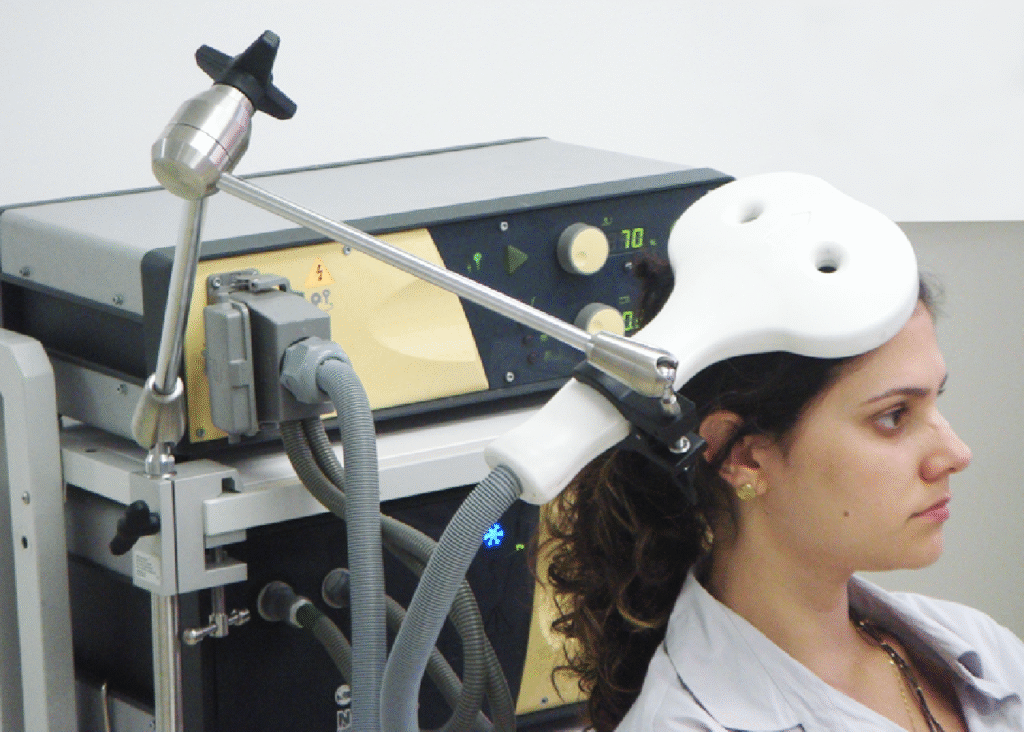
Image source: Wikipedia
2. Transcranial Direct Current Stimulation (tDCS)
- Uses a low electrical current passed through electrodes on the scalp
- Modulates brain activity rather than directly triggering it
- Portable and relatively low-cost
Studies suggest tDCS can reduce craving intensity, though results are more variable than TMS (Klauss et al., 2018).
3. Deep Brain Stimulation (DBS)
- Involves surgically implanting electrodes in specific brain regions
- Used in severe neurological or psychiatric conditions
- Still experimental in addiction
Because it is invasive, DBS is not commonly used and is limited to research settings.
How are these different from therapy or medication?
- Therapy works at the level of thoughts, emotions, and behavior
- Medications act on brain chemistry
- Brain stimulation directly targets brain activity and circuits
These approaches are not replacements for each other. Brain stimulation is usually studied as an add-on to existing treatments, not a standalone solution.
Are these techniques safe?
Non-invasive methods like TMS and tDCS are generally well-tolerated. Common side effects include mild headache or scalp discomfort. Serious side effects are rare when used under clinical supervision (Ekhtiari et al., 2019).
How do these techniques help with addiction?
Addiction affects key brain systems involved in:
- Reward (dopamine pathways)
- Motivation (wanting the substance)
- Self-control (prefrontal cortex)
Over time, the brain becomes more sensitive to substance-related cues and less effective at controlling impulses. This makes cravings stronger and harder to resist (Goldstein & Volkow, 2011).
Which brain areas are targeted?
Most techniques focus on the prefrontal cortex, especially the dorsolateral prefrontal cortex (DLPFC). This region plays a key role in:
- Decision-making
- Impulse control
- Regulating cravings
Addiction is often linked to reduced activity in these areas, making it harder to resist urges (Goldstein & Volkow, 2011).
How does brain stimulation reduce cravings?
- Strengthening self-control: Stimulation can increase activity in the prefrontal cortex, helping improve decision-making and the ability to resist urges.
- Reducing cue reactivity: Substance-related cues (like seeing alcohol or being in certain environments) activate craving pathways. Brain stimulation may reduce how strongly the brain reacts to these cues (Ekhtiari et al., 2019).
- Modulating reward pathways: Addiction disrupts dopamine signaling, making substances feel more rewarding than everyday activities. Brain stimulation may help rebalance these pathways, reducing the intensity of cravings.
- Improving emotional regulation: Cravings are often triggered by stress or difficult emotions. By influencing brain regions involved in mood and regulation, these techniques may help reduce emotionally driven urges.
Do these effects last?
Brain stimulation shows potential for longer-lasting changes, but it is not a one-time solution, and ongoing treatment may be needed to maintain its effects. Most protocols involve multiple sessions over days or weeks, rather than a single treatment.
In many studies, people may start noticing changes after a few sessions, but more consistent reductions in cravings are typically seen after repeated sessions. This is because brain stimulation works by gradually changing how brain circuits function, a process often referred to as neuroplasticity.
Some research suggests that:
- Short-term effects (during or right after treatment) can include reduced craving intensity and improved impulse control
- Longer-term effects may last weeks to a few months, especially when sessions are repeated and structured (Ekhtiari et al., 2019; Hanlon et al., 2015)
However, results are not consistent across all studies. In some cases, the effects fade over time without maintenance sessions and vary depending on the substance, stimulation type, and treatment protocol. Because of this, some researchers suggest the need for booster sessions to maintain benefits and combining brain stimulation with therapy or medication for more sustained outcomes.
What does research say?
Research on brain stimulation for addiction is growing, and the findings are promising but still mixed. Across reviews and meta-analyses, the strongest evidence so far is for repetitive transcranial magnetic stimulation (rTMS/TMS), while transcranial direct current stimulation (tDCS) also shows potential but with less consistent results. Overall, studies suggest these techniques may help reduce craving, and in some cases also reduce substance use or support relapse prevention.
Which techniques have the best evidence?
Among the different approaches, rTMS currently has the strongest support. A large 2024 systematic review and meta-analysis found that rTMS was associated with medium to large reductions in both craving and substance use, especially when treatment involved multiple sessions and targeted the left dorsolateral prefrontal cortex (DLPFC). The same review found that tDCS also showed beneficial effects, but these were more variable and less robust than rTMS.
What does the evidence say about tDCS?
A 2024 meta-analysis focused specifically on tDCS found that it can reduce substance craving, but the size of the benefit differs across studies. The authors noted that results may depend on factors like the type of substance, the brain area targeted, and the stimulation setup used in the study. This means tDCS is promising, but the field still needs more standardized protocols before strong conclusions can be made.
At this stage, the research suggests that brain stimulation techniques, especially rTMS, may help reduce cravings and could become a useful adjunct treatment in addiction care. But they are not yet a proven cure, and they should not be presented as a replacement for therapy, medication, or structured treatment. More large, well-designed studies are still needed to understand who benefits most, which substances respond best, and how long the effects last.
How Does TMS Work in Practice? And How Is It Used in Treatment?
Transcranial Magnetic Stimulation (TMS) uses a coil placed on the scalp to deliver magnetic pulses to specific brain areas. These pulses create small electrical currents in the brain, which can either increase or regulate activity in targeted regions.
A typical TMS session is outpatient and non-invasive. The person is awake and seated in a chair and a coil is placed on the scalp near the target brain area. During the session magnetic pulses are delivered in short bursts and the person may feel a tapping sensation on the scalp.
The sessions usually last 20–40 minutes. Treatment is typically structured as daily sessions (5 days a week) or over 2–6 weeks, depending on the protocol. There is no need for anesthesia, and people can usually return to daily activities immediately after.
How is TMS included in a treatment plan?
TMS is not used as a standalone treatment. It is usually added to a broader, structured plan that may include:
- Therapy (e.g., CBT, relapse prevention)
- Medication-assisted treatment (MAT) where relevant
- Lifestyle and support systems (routine, social support, recovery programs)
When is TMS typically considered?
TMS may be considered when cravings remain strong despite standard treatment and there is a high risk of relapse. It is usually used when other treatments have not been fully effective. It is still an adjunct treatment, meaning it supports, not replaces, existing approaches.
Conclusion: Can Brain Stimulation Help With Cravings?
Brain stimulation techniques offer a new way of understanding and treating cravings. Instead of focusing only on behavior or willpower, they target the brain circuits involved in reward, impulse control, and emotional regulation.
Current research suggests that approaches like TMS can help reduce craving intensity and may support recovery, especially when delivered over repeated sessions. However, the evidence is still evolving. Results are not always consistent, and these techniques do not work the same way for everyone or every substance.
It is important to be clear about what brain stimulation can and cannot do. It is not a cure for addiction, and it does not replace therapy, medication, or structured care. Instead, it works best as a supportive tool, helping reduce cravings and making it easier for a person to engage in recovery.
Sources
Ekhtiari, H., Tavakoli, H., Addolorato, G., Baeken, C., Bonci, A., Campanella, S., … & George, M. S. (2019). Transcranial electrical and magnetic stimulation (tES and TMS) for addiction medicine: A consensus paper on the present state of the science and the road ahead. Neuroscience & Biobehavioral Reviews, 104, 118–140.
Goldstein, R. Z., & Volkow, N. D. (2011). Dysfunction of the prefrontal cortex in addiction: Neuroimaging findings and clinical implications. Nature Reviews Neuroscience, 12(11), 652–669.
Hanlon, C. A., Dowdle, L. T., Austelle, C. W., DeVries, W., Mithoefer, O., Badran, B. W., … & George, M. S. (2015). What goes up, can come down: Novel brain stimulation paradigms may attenuate craving and craving-related neural circuitry in substance dependent individuals. Brain Research, 1628, 199–209.
Kirsch, D. L., & Nichols, F. (2013). Cranial electrotherapy stimulation for treatment of anxiety, depression, and insomnia. Psychiatric Clinics of North America, 36(1), 169–176.
Klauss, J., Anders, Q. S., Felippe, L. V., Nitsche, M. A., & Nakamura-Palacios, E. M. (2018). Multiple sessions of transcranial direct current stimulation (tDCS) reduced craving and relapses for alcohol use: A randomized placebo-controlled trial in alcohol use disorder. Frontiers in Pharmacology, 9, 716.
Mayer, A. R., Dorflinger, J. M., Rao, S. M., & Seidenberg, M. (2016). Neural networks underlying recovery from alcohol dependence: A longitudinal functional MRI study. Addiction Biology, 21(4), 1025–1035.
Mishra, B. R., Nizamie, S. H., Das, B., & Praharaj, S. K. (2015). Efficacy of repetitive transcranial magnetic stimulation in alcohol dependence: A sham-controlled study. Addiction, 105(1), 49–55.
Sayette, M. A. (2016). The role of craving in substance use disorders: Theoretical and methodological issues. Annual Review of Clinical Psychology, 12, 407–433.
Sofuoglu, M., DeVito, E. E., Waters, A. J., & Carroll, K. M. (2013). Cognitive function as an emerging treatment target for marijuana addiction. Experimental and Clinical Psychopharmacology, 21(6), 491–500.
Song, S., Zilverstand, A., Gui, W., Li, H. J., & Zhou, X. (2023). Effects of transcranial direct current stimulation on craving in substance use disorders: A meta-analysis. Psychiatry Research, 324, 115224.
Volkow, N. D., Koob, G. F., & McLellan, A. T. (2016). Neurobiologic advances from the brain disease model of addiction. New England Journal of Medicine, 374(4), 363–371.
Witkiewitz, K., & Bowen, S. (2010). Depression, craving, and substance use following a randomized trial of mindfulness-based relapse prevention. Journal of Consulting and Clinical Psychology, 78(3), 362–374.
Jansen, J. M., van Wingen, G., van den Brink, W., & Goudriaan, A. E. (2013). Resting state connectivity in alcohol dependent patients and the effect of repetitive transcranial magnetic stimulation. European Neuropsychopharmacology, 23(7), 755–763.
Zhang, J., Ma, Y., & Li, Y. (2023). Repetitive transcranial magnetic stimulation in the treatment of substance use disorders: A systematic review and meta-analysis. Neuropsychopharmacology, 48, 1234–1245.