Switching from Cigarettes to Vaping: Does It Really Help You Quit?
Introduction
If you smoke and have ever thought, “Maybe vaping is a better option”, you’re not alone. Many people reach this point after several failed quit attempts, health scares, or simply feeling tired of the cycle of craving, guilt, and relapse. Vapes are often presented as a cleaner, safer, or more modern alternative to cigarettes and that can sound reassuring when quitting feels overwhelming.
At the same time, the information around vaping is confusing and often contradictory. Some people say it helped them quit. Others say they got more addicted. Doctors, governments, and public health bodies don’t always seem to agree. Add flashy marketing, flavours, and easy access, and it becomes hard to separate evidence from opinion.
This blog takes a neutral, evidence-based look at switching from cigarettes to vaping. It explores what vaping is, how it differs from smoking, what research says about quitting, addiction risks, health effects, legal status in India, and safer ways to quit, so you can make an informed decision rather than a rushed or fear-driven one.
What is a vape and how does vaping work?
A vape, also called an e-cigarette, is a device designed to deliver nicotine without burning tobacco. Unlike cigarettes, which work through combustion, vapes heat a liquid and turn it into an aerosol that is inhaled. This difference matters because burning tobacco produces thousands of harmful chemicals, many of which are known to cause cancer and heart disease.
What exactly is vaping?
Vaping involves inhaling an aerosol created by heating a liquid, commonly called e-liquid or vape juice. The aerosol is often mistaken for “water vapour,” but it is not harmless steam. It contains fine particles, flavouring chemicals, and sometimes nicotine, which can affect the lungs and cardiovascular system.
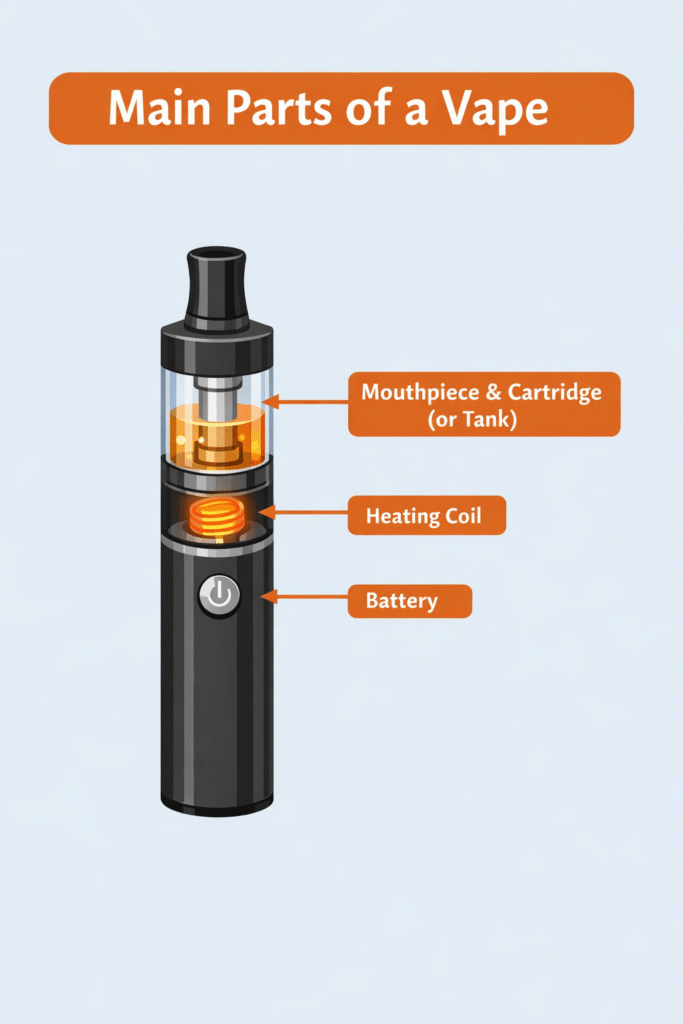
What are the main parts of a vape?
Most vape devices have three basic components:
- A battery that powers the device
- A heating coil that warms the liquid
- A cartridge or tank that holds the e-liquid
When the device is activated, the coil heats the liquid and produces an aerosol that is inhaled through the mouthpiece.
What is E-liquid made of?
E liquid usually contains:
- Propylene glycol (PG) and vegetable glycerin (VG), which create the aerosol
- Flavouring agents, which give vapes their taste
- Nicotine, in varying strengths
Note: Even nicotine-free liquids are not risk-free. Studies show that some flavouring chemicals can irritate the lung tissue and trigger inflammation when inhaled repeatedly.
Freebase Nicotine vs Nicotine Salts
There are two common forms of nicotine used in vapes:
- Freebase nicotine delivers a stronger throat hit and is usually found in lower concentrations.
- Nicotine salts allow higher nicotine levels with less throat irritation, making them easier to inhale, especially for new users.
Nicotine salts are absorbed quickly and can make dependence develop faster, particularly in people who vape frequently without realizing how much nicotine they are consuming.
Why vaping can feel “smoother” than smoking
Because vaping does not involve smoke or tar, it often feels less harsh on the throat and chest. This can make people inhale more deeply or use the device more often. From a psychological perspective, this “smoothness” can lower the body’s natural stop signals, increasing the risk of overuse.
In short, vaping works differently from smoking, but it is not risk-free. Understanding how it functions is the first step in deciding whether it actually supports quitting or simply changes the form of nicotine dependence.
How is vaping different from smoking cigarettes?
At a surface level, vaping and smoking can look similar, both involve inhaling something into the lungs. But logically and chemically, they work in very different ways. Understanding this difference is important, when people assume vaping is simply a “cleaner cigarette.”
Combustion vs Heating
Cigarettes work through combustion. When tobacco burns, it produces smoke containing over 7000 chemicals, including tar, carbon monoxide, and dozens of known carcinogens. These by-products are responsible for most smoking-related diseases.
Vapes, on the other hand, do not burn tobacco. They heat a liquid to create an aerosol. This means vapes generally expose users to fewer toxic substances than cigarettes, but fewer does not mean none.
Nicotine delivery feels different
Cigarettes deliver nicotine very rapidly to the brain, producing a sharp spike that many smokers experience as a “hit.” The fast delivery plays a key role in how addictive cigarettes are.
Vapes can vary widely. Some deliver nicotine more slowly, while others, especially those using nicotine salts, can deliver equal or ever higher levels of nicotine with less throat irritation. Psychologically, this smoother delivery can encourage more frequent use without the user fully noticing how much nicotine they are consuming.
Exposure to toxins and irritants
Smoking exposes the lungs to tar and fine particles that damage lung tissue and blood vessels over time. This link to cancer, heart disease, and chronic lung illness is well established.
Vaping exposes the lungs to fewer known carcinogens, but studies show it can still cause airway irritation, inflammation, and oxidative stress (an imbalance where harmful molecules damage cells and tissues in the body), especially with long-term or heavy use. The long-term health effects are still being studied, which means uncertainty remains.
The psychological experience is also different
Many smokers report that cigarettes feel more “satisfying,” while vapes feel easier to use repeatedly. From a behavioral standpoint, vaping can blur boundaries, there is no clear start or end like a cigarette, which can increase habitual use throughout the day.
Is Vaping Recommended for Quitting Smoking?
This is one of the most common and most misunderstood questions around vaping. The short answer is: vaping is not universally recommended as a first-line quitting tool, but some health bodies view it differently depending on context.
What do global health bodies say?
Major public health organization take a cautious stane. The World Health Organization does not recommend vaping as a smoking cessation tool. Its position is based on two concerns:
- The long-term health effects of vaping are still unclear.
- Vaping can maintain or even increase nicotine dependence, especially with high-nicotine products.
Similarly, bodies like the Centers for Disease Control and Prevention emphasize that no e-cigarette has been approved as a safe or effective quitting aid. They continue to recommend evidence-based treatments like nicotine replacement therapy (NRT) and behavioral support.
That said, some countries take a harm-reduction approach. For example, the UK’s National Health Service acknowledges that vaping is likely less harmful than smoking and may help some adults quit when other methods have failed. Even then, it is framed as a temporary step, not a long-term solution.
What is the recommendation in India?
In India, the stance is much stricter. The government has not endorsed vaping for quitting smoking, and the sale of e-cigarettes is prohibited under the Prohibition of Electronic Cigarettes Act 2019.
Indian health authorities emphasize complete nicotine cessation using approved methods like counselling, nicotine patches, gum, and medical support. This approach is shaped by concerns around youth uptake, unregulated products, and lack of long-term safety data.
Does Vaping Actually Help People Quit Smoking?
This is where the evidence becomes nuanced. The idea that vaping helps people quit smoking is partly supported by research, but it is far from a guaranteed or universal solution.
What research shows about quit rates
Some studies suggest that vaping can help a subset of smokers quit cigarettes, especially when compared to no support at all. A well-known randomized controlled trial found that e-cigarettes were more effective than traditional nicotine replacement therapy (NRT) when both combined with behavioral counseling (Hajek et al., 2019).
However, there’s an important detail often missed, in that study, most people who quit smoking vapes were still using e-cigarettes one year later. In contrast, those using NRT were more likely to stop all nicotine use. From a psychological perspective, this matters because the goal of quitting is usually from dependence, not just switch delivery systems.
Reduction is not the same as quitting
Many people report smoking fewer cigarettes after switching to vaping. While reduction can lower exposure to toxins, it is not the same as quitting. Studies show that people who “cut down” but continue smoking still carry significant health risks. Vaping may reduce harm relative to smoking, but it does not automatically lead to full cessation.
The problem of dual use
A common outcome is dual use, where people both smoke and vape. Research shows that dual users often consume similar or even higher levels of nicotine than before, while continuing to expose their lungs to cigarette smoke. From a behavioral standpoint, vaping can sometimes make it easier to maintain smoking habits.
Why some people feel “stuck” with vaping
Psychologically, vaping removes many natural stopping cues. There is no clear endpoint like finishing a cigarette. The device is easy to use, discreet and often flavoured. This can lead to frequent, automatic use throughout the day, reinforcing dependence. For some people, vaping becomes less a quitting tool and more a new habit layered onto old ones.
Is Vaping More Addictive Than Smoking?
Addiction is not only about what substance is used, but how it is delivered and how often it is consumed. From this perspective, vaping can sometimes be as addictive as smoking, and in certain situations even more so.
Nicotine is still the primary driver of addiction
Both cigarettes and more vapes deliver nicotine, which is a highly addictive substance. Nicotine affects the brain’s reward system by releasing dopamine, reinforcing repeated use and making stopping difficult.
What changes with vaping is control and variability. Nicotine levels in vapes can range widely and many users are unaware of how much they are consuming, especially when using high strength liquids or nicotine salts.
Why vaping can increase frequency of use
Cigarettes have built-in limits. A cigarette has a beginning and an end. Vapes do not. Because vaping feels smoother and less harsh, people tend to take more frequent puffs throughout the day. This pattern, sometimes called “grazing,” can maintain constant nicotine levels in the brain, strengthening dependence without the user noticing.
Role of flavours and accessibility
Flavoured e-liquids make vaping more palatable and less aversive, especially for new users. Research shows that flavours increase appeal, repeated use, and difficulty quitting, particularly among younger adults.
Ease of access also matters. Vapes can be used discreetly, indoors or in situations where smoking is not allowed. From a behavioral standpoint, fewer barriers mean stronger habits.
Nicotine salts and faster dependence
Nicotine salts allow higher doses of nicotine to be inhaled comfortable. This can lead to rapid nicotine delivery that closely mimics or exceeds the nicotine spikes seen with cigarettes, increasing addiction risk.
For some users, especially those trying to quit smoking, this can unintentionally deepen dependence rather than reduce it.
Addiction is more than chemistry
Addiction is also shaped by habit loops like cue, behavior, and reward. Vaping can become linked to stress relied, boredom, social situations, or emotional regulation. Over time, this device itself becomes a coping tool, making psychological dependence just as strong as physical dependence.
What About Non-Nicotine Vaping and Other Smoking Alternatives? Are They Safe?
When people hear about the risks of nicotine, a common next thought is, “what if I vape without nicotine?” These options are often marketed as safer but the evidence suggests the picture is more complicated.
Is non-nicotine vaping safe?
Non-nicotine vapes do not contain nicotine, so they do not cause nicotine dependence. That is an important difference. However, absence of nicotine does not mean absence of harm.
Non-nicotine e-liquids still contain propylene glycol, vegetable glycerin, and flavouring chemicals. When heated and inhaled, these substances can irritate the airways and trigger inflammation in the lungs. Some flavouring agents have been shown to be toxic to lung cells when inhaled repeatedly, even though they are considered safe to eat.
Non-nicotine smoking can still reinforce habitual hand-to-mouth behavior and emotional coping patterns linked to smoking. This can make it harder to fully disengage from the smoking ritual.
What about herbal cigarettes?
Herbal cigarettes are often promoted as “natural,” “tobacco-free,” or “chemical-free.” While they may not contain nicotine or tobacco, they are still burned.
Combustion is the key issue. Burning any plant material produces tar, carbon monoxide, and fine particles that damage the lungs and cardiovascular system. Research shows that herbal cigarettes expose users to many of the same harmful by-products as regular cigarettes. In other words, herbal does not mean harmless.
Other smoking alternatives (hookah, heat-not-burn products)
Products like hookah or heated tobacco devices are sometimes perceived as gentler alternatives. However, studies show that they can still deliver significant levels of toxic chemicals and in some cases, high nicotine exposure. Longer sessions and deeper inhalations can further increase the risk.
Risks to Keep in Mind When Switching From Cigarettes to Vaping
Switching from cigarettes to vaping is often framed as a safer or healthier move. While it may reduce exposure to some harmful chemicals, it also comes with specific risks that are easy to overlook, especially when the goal is to quit smoking altogether.
Replacing one dependence with another
One of the biggest risks is substitution rather than cessation. Many people stop smoking cigarettes but continue using vapes for years. This means the brain remains dependent on nicotine and the habit loop stays intact.
Increased frequency and invisible use
Because vaping feels smoother and is more socially acceptable in many settings, people often use it more frequently than they smoked. There are no clear stopping points, which can lead to constant, low-level nicotine exposure throughout the day. This pattern can strengthen dependence while giving the illusion of control.
Dual use: smoking and vaping together
A common outcome is dual use, where people vape but still smoke occasionally. Research shows that this pattern is widespread and limits any health benefits, since exposure to cigarette smoke continues.
Higher nicotine intake without realizing it
Many vape liquids, especially those with nicotine salts contain high nicotine concentrations. Because the throat irritation is lower, users may consume more nicotine than they did with cigarettes, without feeling it immediately. This can increase dependence and withdrawal symptom when trying to stop.
Unregulated products and safety concerns
In countries like India, where vapes are restricted, many products are unregulated. This increases the risk of contaminated or poorly manufactured liquids, inconsistent nicotine levels an unknown additives. This certainly adds another layer or risk.
Delaying a clear quit plan
Perhaps the most subtle risk is psychological. When vaping is seen as a “good enough” solution, it can delay setting a clear goal to stop nicotine use entirely. Harm reduction can be useful, but without an exit plan, it can quietly become a long-term habit.
When Is It Time to Quit Smoking and How Do You Know What You Need?
Most smokers don’t wake up one day feeling completely ready to quit. The decision usually builds over time, after health concerns, repeated failed attempts, or simply feeling tired of being dependent. The “right time” to quit is less about perfect motivation and more about recognizing patterns that signal support is needed.
Signs that it’s time to quit
It may be time to actively plan quitting if you notice:
- You smoke to cope with stress, anxiety or low mood
- You feel uncomfortable or irritable when you can’t smoke
- You’ve tried quitting before but relapsed quickly
- Health symptoms like breathlessness, cough, or fatigue are increasing
Research shows that repeated quit attempts are common and normal. Most successful quitters have tried several times before stopping for good.
Nicotine dependence
Nicotine dependence varies in intensity. Some people experience mild craving, while others deal with strong withdrawal symptoms like restlessness, irritability, poor concentration and sleep disturbance.
These symptoms are not a lack of willpower. They reflect changes in brain chemistry caused by long-term nicotine exposure. Understanding this can reduce self-blame and make it easier to seek the right kind of help.
How to know what kind of support you need
A rough guide:
- Mild dependence: You may manage with behavioral strategies, lifestyle changes and strong social support.
- Moderate dependence: Nicotine gum or lozenges can help manage cravings during high-risk moments.
- Higher dependence: Nicotine patches, combination NRT, or medical support can significantly improve success rates.
Evidence consistently shows that nicotine replacement therapy (NRT) doubles the chances of quitting successfully compared to unaided attempts.
When might people consider vaping?
From an evidence-based perspective, vaping may be considered only when:
- Multiple quit attempts using approved methods have failed
- The person continues to smoke heavily
- There is a clear intention to reduce and eventually stop nicotine use
Even then, vaping should be viewed as a temporary harm-reduction step, not a long-term solution.
Reduce nicotine level over time
If vaping is used at all, the clear goal should be gradual nicotine reduction, not indefinite use. Staying on high nicotine levels can reinforce dependence and make quitting harder later.
Reducing nicotine strength step by step allows the brain to adjust, lowers withdrawal intensity, and increases the chances of eventually stopping nicotine altogether. Without a reduction plan, vaping often becomes a long-term substitute rather than a bridge to quitting.
Support matters more than method
Quitting is not just about managing nicotine. It also involves breaking routines, learning new coping skills, and handling emotional triggers. Behavioral counselling, therapy, or structured quit programs significantly improve outcomes when combined with any nicotine-reduction method.
Are There Better, Evidence-Based Ways to Quit Smoking?
Yes, decades of research show that some methods are far more effective and safer than switching products on your own. From a medical perspective, the most successful approaches target both nicotine dependence and behavioral change.
Nicotine replacement therapy (NRT)
Nicotine replacement therapy includes patches, gum, lozenges, inhalers, and nasal sprays. These deliver controlled doses of nicotine without exposing the body to the harmful by-products of smoke.
Large reviews consistently show that NRT significantly increases quit success, especially when used correctly and for adequate duration. Using long-acting patch alongside short-acting gum or lozenges for cravings works better than using one form alone. NRT is designed to be tapered and stopped, making it a structured exit rather than a replacement habit.
Behavioral counseling and psychological support
Smoking is not just a chemical addiction, it is a learned coping strategy. Counselling helps people identify triggers, manage cravings and develop alternative ways to deal with stress, boredom and emotional discomfort.
Studies show that even brief counseling sessions can improve quit rates, and longer or repeated support increases success further. Cognitive-behavioral strategies, motivational interviewing, and relapse prevention skills are particularly effective.
Combining medication and therapy works best
The strongest evidence supports combined treatment using medications (like NRT or prescription support) along with behavioral counseling. This combination addresses both the brain’s dependence on nicotine and the habits that keep smoking going. Compared to quitting without support, combined approaches can double or even triple success rates (Fiore et al, 2008).
Why “willpower alone” often fails
Many smokers blame themselves for relapse. In reality, unassisted quit attempts have low long-term success rates. This is not due to weak motivation, but because nicotine changes brain chemistry and stress response systems. Using support is not a sign of weakness, it is an evidence-based strategy.
Where does vaping fit in?
Compared to these methods, vaping is less predictable and less regulated. While it may reduce harm for some people who cannot quit otherwise, it lacks the structure and safety data of approved treatments.
Conclusion
Switching from cigarettes to vaping may reduce exposure to some harmful chemicals, but it is not a risk-free or universally recommended way to quit. For many people, it simply changes the form of nicotine dependence rather than ending it.
From an evidence-based perspective, the safest and most effective path is one that combines proven nicotine support, behavioral strategies, and a clear plan to stop nicotine altogether. Quitting is rarely about willpower alone, it’s about choosing support that matches your needs and helps you move toward lasting change.
Sources
Allen, J. G., Flanigan, S. S., LeBlanc, M., Vallarino, J., MacNaughton, P., Stewart, J. H., & Christiani, D. C. (2016). Flavoring chemicals in e-cigarettes: Diacetyl, 2,3-pentanedione, and acetoin in a sample of 51 products, including fruit-, candy-, and cocktail-flavored e-cigarettes. Environmental Health Perspectives, 124(6), 733–739.
Baker, T. B., Piper, M. E., McCarthy, D. E., Majeskie, M. R., & Fiore, M. C. (2004). Addiction motivation reformulated: An affective processing model of negative reinforcement. Psychological Review, 111(1), 33–51.
Benowitz, N. L. (2010). Nicotine addiction. New England Journal of Medicine, 362(24), 2295–2303.
Benowitz, N. L., St Helen, G., & Dempsey, D. A. (2019). Nicotine delivery and vaping behavior during ad libitum e-cigarette access. Tobacco Regulatory Science, 5(2), 152–163.
Fiore, M. C., Jaén, C. R., Baker, T. B., Bailey, W. C., Benowitz, N. L., Curry, S. J., … Wewers, M. E. (2008). Treating tobacco use and dependence: 2008 update. Clinical practice guideline. U.S. Department of Health and Human Services.
Gan, Q., Smith, K. R., Hammond, S. K., & Hu, T. (2009). Disease burden of adult lung cancer and ischaemic heart disease from passive tobacco smoking in China. Tobacco Control, 16(6), 417–422.
Glantz, S. A., & Bareham, D. W. (2018). E-cigarettes: Use, effects on smoking, risks, and policy implications. Annual Review of Public Health, 39, 215–235.
Gotts, J. E., Jordt, S. E., McConnell, R., & Tarran, R. (2019). What are the respiratory effects of e-cigarettes? BMJ, 366, l5275.
Hajek, P., Phillips-Waller, A., Przulj, D., Pesola, F., Myers Smith, K., Bisal, N., … McRobbie, H. J. (2019). A randomized trial of e-cigarettes versus nicotine-replacement therapy. New England Journal of Medicine, 380(7), 629–637.
Leventhal, A. M., Goldenson, N. I., Cho, J., Kirkpatrick, M. G., McConnell, R. S., Stone, M. D., & Barrington-Trimis, J. L. (2019). Flavored e-cigarette use and progression of vaping in adolescents. Pediatrics, 144(5), e20190789.
National Academies of Sciences, Engineering, and Medicine. (2018). Public health consequences of e-cigarettes. National Academies Press.
U.S. Surgeon General. (2014). The health consequences of smoking—50 years of progress: A report of the Surgeon General. U.S. Department of Health and Human Services.
U.S. Surgeon General. (2020). Smoking cessation: A report of the Surgeon General. U.S. Department of Health and Human Services.
World Health Organization. (2020). WHO statement on heated tobacco products and electronic nicotine delivery systems. World Health Organization.
World Health Organization. (2023). WHO report on the global tobacco epidemic. World Health Organization.
Cochrane Tobacco Addiction Group. (2020). Nicotine replacement therapy versus control for smoking cessation. Cochrane Database of Systematic Reviews.